Delayed Tooth Eruption in Children: When Should Parents Worry?
Dr. Mark Tavakoli
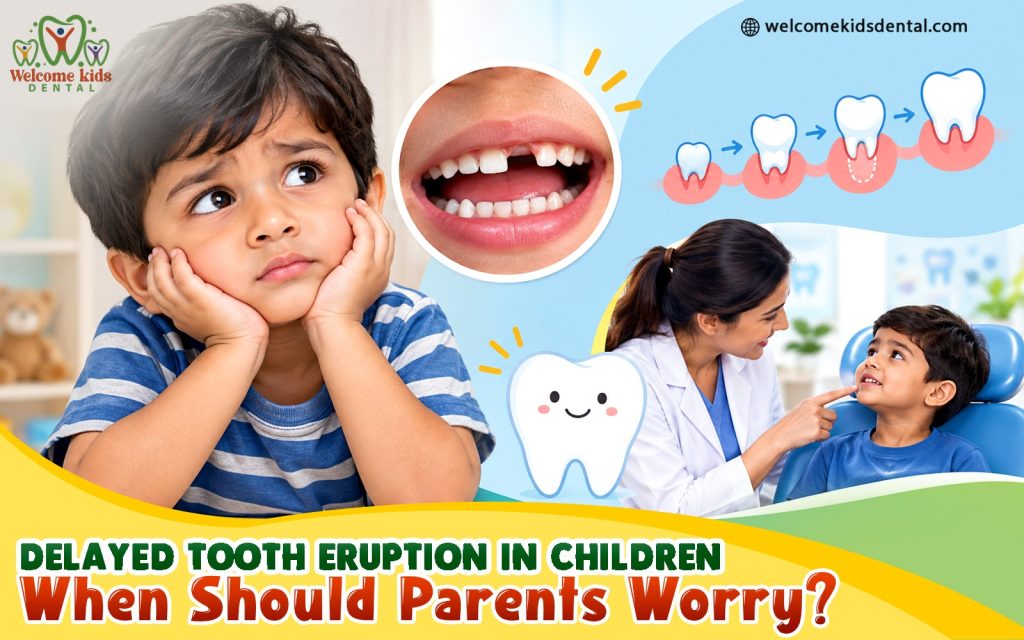
Parents often have a general idea of when their child’s baby teeth should appear and when permanent teeth should begin replacing them. But what happens when a tooth seems to be taking much longer to come in?
Delayed tooth eruption is fairly common, and a tooth being late does not automatically mean something is wrong. Children develop at different rates, and normal eruption can vary from one child to another. However, a noticeably delayed tooth can sometimes signal a lack of space, an impacted tooth, a developmental issue, or another problem that needs attention.
Regular Pediatric preventive dentistry appointments allow a dentist to monitor how a child’s teeth and jaws are developing and determine whether an eruption pattern is within the expected range.
So, when should parents worry about a tooth that has not appeared? Understanding what is normal, what can cause delays, and which signs deserve an evaluation can help parents know when to seek professional advice.
What Is Delayed Tooth Eruption in Children?
Delayed tooth eruption means that a tooth has not appeared in the mouth within the expected developmental timeframe.
Every child has a unique eruption pattern, so there is no single age at which every tooth must appear. Baby teeth generally begin emerging during infancy, while permanent teeth start replacing them during early childhood and continue erupting through the preteen years. A slight difference in timing is usually not concerning. The bigger question is whether the delay is significant compared with the child’s other teeth or whether there are signs that something is preventing the tooth from erupting.
For example, if the permanent teeth on one side of the mouth have erupted but the corresponding tooth on the other side remains missing for an extended period, a dentist may want to investigate.
Delayed eruption can affect:
- Baby teeth
- Permanent teeth
- One tooth or several teeth
- Teeth in the upper or lower jaw
A tooth may simply be developing more slowly, or it may be physically blocked from reaching the mouth.
Parents should therefore look at the overall eruption pattern rather than focusing on a specific date.
When Is a Tooth Considered Late?
One of the most common questions parents ask is, “How late is too late for a tooth to come in?” There is no universal deadline that applies to every child. Children develop at different rates, and tooth eruption can vary based on genetics, growth, and the individual tooth involved. Dentists therefore look at the child’s overall dental development rather than relying on a specific age alone.
A small delay may be completely normal, especially if the child’s other teeth are erupting normally. However, a dental evaluation becomes more important when:
- One tooth is significantly behind the corresponding tooth on the opposite side
- A permanent tooth has not appeared while neighboring permanent teeth have already erupted
- A baby tooth remains in place unusually long
- There is no visible sign of an expected permanent tooth
- A tooth appears to be erupting in an unusual direction
- The child has swelling or discomfort around an unerupted tooth
- Teeth are becoming increasingly crowded
- A space where a permanent tooth should appear is closing or changing noticeably
The position of the tooth matters just as much as the timing. A permanent tooth may already be developing beneath the gums but may be unable to erupt because another tooth is blocking its path. In some cases, the tooth may be angled incorrectly or there may simply not be enough room in the dental arch.
Parents should also pay attention to differences between the two sides of the mouth. While teeth do not always erupt at exactly the same time, a significant difference between matching teeth can sometimes indicate that one tooth is having difficulty following its normal eruption path.
A delayed tooth does not automatically mean that treatment is needed. Sometimes, the best approach is simply to monitor the tooth and give it more time to erupt naturally. In other cases, waiting too long can allow crowding or blockage to become more difficult to manage.
A dentist can examine the child’s mouth and, when necessary, use dental X-rays to determine whether the permanent tooth is present, where it is located, and whether anything is preventing it from erupting. This helps parents understand whether the tooth is simply developing slowly or whether further evaluation may be needed.
What Causes Delayed Tooth Eruption in Children?
There are many possible reasons a tooth may be late to erupt. Some are temporary and harmless, while others may require treatment.
Normal variation
Some children naturally develop teeth later than others. If the child’s overall dental development is progressing normally, a delayed tooth may simply reflect individual variation.
Family patterns
Genetics can influence the timing of tooth eruption. If parents or siblings experienced late eruption, a child may have a similar pattern.
Lack of space
Crowding can prevent a permanent tooth from finding enough room to emerge. The tooth may remain beneath the gums or develop at an unusual angle.
Impacted teeth
An impacted tooth is unable to erupt normally because something is blocking its path. Another tooth, bone, gum tissue, or limited space can interfere with eruption.
Retained baby teeth
Baby teeth are supposed to fall out as permanent teeth develop underneath them. If a baby tooth remains in place longer than expected, it can sometimes interfere with the permanent tooth.
Early loss of baby teeth
When a baby tooth is lost too early, nearby teeth may move into the open space. This can reduce the room available for the permanent tooth.
Extra teeth
In some children, an additional tooth develops and blocks the eruption path of a permanent tooth.
Developmental or health-related factors
Certain medical or developmental conditions can affect the timing of tooth development and eruption. When several teeth are delayed rather than just one, the dentist may consider whether there are broader factors involved.
Not every delayed tooth has an identifiable cause. Sometimes, the reason only becomes clear after a dental examination and imaging.
What Signs Should Parents Watch For?
A delayed tooth is not always easy to spot, especially when it is still beneath the gums. Parents may first notice that a permanent tooth is missing while the surrounding teeth have already erupted.
One of the clearest signs is an uneven eruption pattern. For example, if a child has a permanent tooth on one side but the matching tooth on the opposite side has not appeared, it may be worth mentioning during the next dental visit.
Other signs include:
- A baby tooth that refuses to loosen
- A permanent tooth that seems significantly delayed
- A visible bump in the gum where a tooth is expected
- Swelling around an unerupted tooth
- Teeth becoming crowded or displaced
- A tooth emerging behind or in front of another tooth
- Changes in the child’s bite
- Pain or tenderness around the affected area
Parents should also pay attention to changes that occur gradually. A tooth does not need to cause pain to require evaluation.
In fact, some impacted or delayed teeth cause no symptoms at all. They may only be discovered when a dentist takes an X-ray during a routine examination.
This is one reason regular dental visits are important during the years when permanent teeth are developing.
How Is Delayed Tooth Eruption Diagnosed and Treated?
A dentist begins by examining the child’s mouth and reviewing the eruption pattern. They may compare the timing and position of the child’s teeth with typical developmental patterns while also considering the child’s individual growth.
If the tooth cannot be seen or its position is unclear, dental X-rays may be recommended. An X-ray can show whether the permanent tooth is present, where it is located, whether it is developing normally, and whether another tooth is blocking it.
The dentist may look for:
- The position of the unerupted tooth
- Available space in the dental arch
- The condition of the surrounding teeth
- Signs of impaction
- Abnormal tooth development
- Extra teeth or other obstacles
Treatment depends entirely on the cause.
If the tooth is developing normally and appears likely to erupt naturally, the dentist may simply monitor it over time.
If something is blocking eruption, treatment may focus on removing or addressing that obstacle. In some situations, a retained baby tooth may need to be removed. If there is insufficient space, orthodontic treatment may eventually be recommended to create room and guide the permanent tooth.
For an impacted permanent tooth, treatment may involve coordination between a pediatric dentist and orthodontist. In more complex cases, a specialist may help expose or guide the tooth into its proper position.
The earlier a significant eruption problem is identified, the more opportunities a dental team may have to manage it while the child’s teeth and jaws are still developing.
Regular Children’s dental cleaning in Oakland appointments can also help maintain healthy teeth and gums while dentists continue monitoring eruption and development.
How Welcome Kids Dental Helps Monitor Your Child’s Tooth Development
At Welcome Kids Dental, routine pediatric dental care includes more than checking for cavities. Monitoring how a child’s teeth and jaws develop is an important part of protecting their long-term oral health. Regular visits give the dental team an opportunity to follow the natural progression of baby teeth, permanent teeth, and the developing bite.
During routine appointments, the dental team can look for signs of delayed tooth eruption, unusual tooth positioning, crowding, retained baby teeth, and other changes that may affect permanent tooth development. Comparing changes over time can be particularly helpful because a tooth that appears slightly delayed at one visit may become more concerning if it still has not erupted as neighboring teeth continue to develop.
When a tooth appears to be delayed, parents can discuss their concerns with the dental team and learn whether the eruption pattern appears normal or deserves closer evaluation. If the dentist suspects that a tooth may be blocked, impacted, or developing in an unusual position, dental imaging may be recommended to see what is happening beneath the gums. Based on the findings, the dentist can recommend continued monitoring, preventive care, or further evaluation when appropriate.
Welcome Kids Dental also focuses on making dental visits comfortable and positive for children. This can be especially helpful when a child needs an examination, X-ray, or follow-up appointment to investigate delayed eruption. A calm, child-friendly experience can help reduce fear and make it easier for children to receive the care they need.
Most importantly, parents do not have to wait for a tooth to become painful before asking about it. Many eruption problems cause no symptoms in the early stages. Regular dental visits provide an opportunity to identify concerns while they are still developing and determine whether any action is needed.
If you are unsure whether your child’s teeth are erupting on schedule, discussing your concerns with the team at Welcome Kids Dental can give you a clearer understanding of your child’s individual dental development.
Conclusion
Delayed tooth eruption does not always mean that something is wrong. Children develop at different rates, and some teeth naturally appear later than others. However, a significant delay, an uneven eruption pattern, a retained baby tooth, or signs that a permanent tooth is blocked should be evaluated by a pediatric dentist.
The cause may be something relatively simple, such as normal developmental variation, or it may involve crowding, impaction, retained baby teeth, or another factor affecting the tooth’s eruption path.
Because delayed eruption can sometimes be identified before a child develops symptoms, routine dental examinations are an important part of monitoring permanent teeth.
If your child’s tooth seems unusually late, do not panic—but do not ignore the concern either. A professional evaluation can help determine whether the tooth simply needs more time or whether early treatment could help it erupt properly.
At Welcome Kids Dental, the goal is to monitor children’s developing smiles, identify potential concerns early, and provide age-appropriate care in a comfortable environment. With regular dental visits and timely evaluation when something looks unusual, parents can feel more confident about their child’s changing smile.