What Are Rotated Teeth? Understanding Why Some Children’s Teeth Twist as They Grow
Dr. Mark Tavakoli
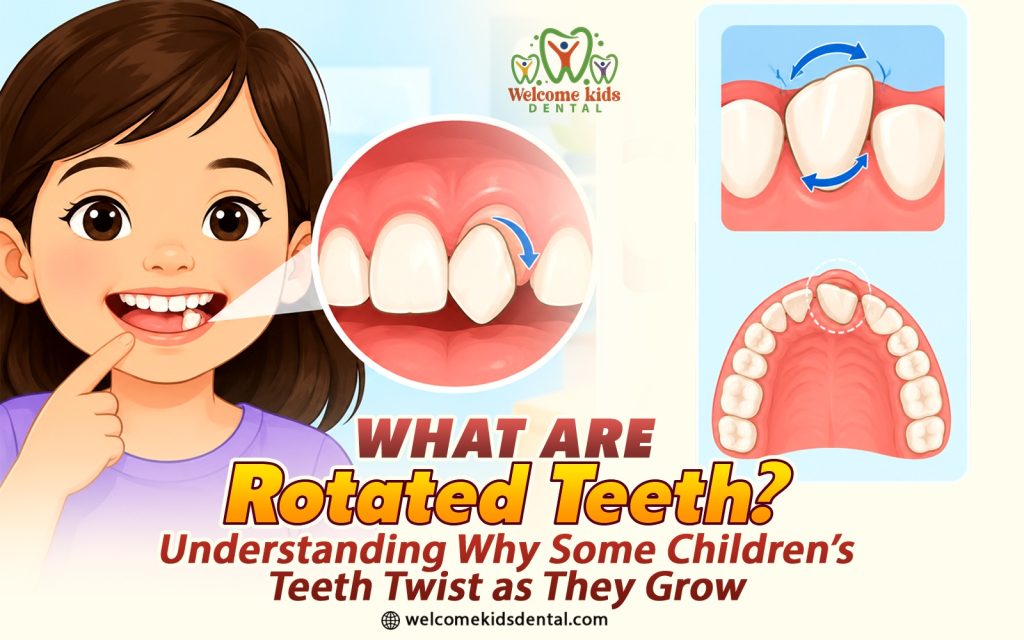
As children’s permanent teeth begin replacing their baby teeth, parents may notice that some teeth do not come in perfectly straight. A tooth may appear slightly turned, angled, or twisted compared with the teeth next to it. This is known as a rotated tooth. Rotated teeth are common during childhood and can range from a minor cosmetic concern to a sign of limited space or another developing bite problem. A tooth may rotate because there is not enough room for it to erupt normally, because neighboring teeth are taking up space, or because the tooth develops along an unusual eruption path.
While a slightly rotated tooth does not always require treatment, significant rotation can affect how the teeth fit together and may make certain areas harder to clean.
Regular Pediatric preventive dentistry visits allow dentists to monitor how permanent teeth are developing and determine whether a rotated tooth is likely to correct itself or may benefit from further evaluation. Understanding why children’s teeth rotate, what parents should watch for, and when treatment may be needed can help families address the concern at the right time.
What Are Rotated Teeth in Children?
A rotated tooth is a tooth that has turned around its normal position within the dental arch. Instead of facing forward or fitting naturally between neighboring teeth, the tooth may appear twisted or angled. The amount of rotation can vary considerably. A tooth may be turned only slightly, making the change difficult to notice, or it may be rotated enough that part of the tooth faces inward or outward.
Rotation can occur in both baby and permanent teeth, but it is often more noticeable when permanent teeth begin erupting.
Parents may notice that:
- One tooth looks twisted compared with the others
- The front surface of a tooth appears to face slightly sideways
- A tooth overlaps a neighboring tooth
- A tooth appears to sit at an unusual angle
- The child has crowding around the affected tooth
- The tooth looks out of alignment when the child smiles
A rotated tooth is different from a tooth that is simply tilted forward or backward. Rotation specifically refers to the tooth turning around its long axis. The appearance of a rotated tooth can sometimes change as neighboring teeth erupt and the dental arch develops. This is why a dentist may recommend monitoring the tooth before deciding whether treatment is necessary.
Why Do Children’s Teeth Rotate as They Grow?
There are several reasons a child’s tooth may become rotated. Often, the underlying issue is related to the amount of space available in the dental arch.
Lack of space
Crowding is one of the most common factors associated with tooth rotation. When there is not enough room for a permanent tooth, it may erupt at an angle or rotate to fit into the available space. Instead of occupying its ideal position, the tooth may turn slightly to squeeze between neighboring teeth.
Crowded dental arches
Children with naturally narrow or crowded dental arches may have several teeth that overlap or rotate. In these cases, rotation may be one part of a larger alignment issue.
Abnormal eruption path
Permanent teeth do not always follow a perfectly straight path as they develop. A tooth may begin moving toward the mouth at an unusual angle and emerge in a rotated position. The location and direction of neighboring teeth can influence this path.
Early loss of baby teeth
Baby teeth help preserve space for permanent teeth. If a baby tooth is lost significantly earlier than expected, nearby teeth can shift into the empty space. When the permanent tooth eventually begins to erupt, the altered space may affect its position and cause it to rotate.
Delayed loss of baby teeth
The opposite can also occur. If a baby tooth remains in place longer than expected, it may interfere with the eruption path of the permanent tooth developing underneath it. The permanent tooth may then emerge in a less favorable position.
Tooth size and jaw size
Sometimes, the size of the permanent teeth does not match the available space in the dental arch. Larger teeth in a relatively small dental arch can increase the likelihood of crowding and rotation.
Extra teeth
An additional tooth can occasionally develop and interfere with the normal eruption of a permanent tooth. If the extra tooth occupies space in the eruption path, the permanent tooth may become displaced or rotated.
Oral habits
Certain prolonged oral habits can influence tooth position and bite development. The effects depend on the habit, frequency, intensity, and duration, and they do not affect every child in the same way.
What Signs of Rotated Teeth Should Parents Watch For?
Rotated teeth are often easy to identify once they have erupted, but the early signs may be subtle.
Parents may notice that one tooth looks different from its matching tooth on the opposite side. A front tooth may appear slightly twisted, while a back tooth may look as though it is sitting at an unusual angle.
Other signs include:
- Teeth overlapping each other
- Increasing crowding
- A permanent tooth erupting behind or in front of another tooth
- A tooth appearing unusually narrow or wide from certain angles
- Difficulty brushing around the affected tooth
- Food becoming trapped between crowded teeth
- A noticeable change in the child’s bite
It is important not to judge the severity of the problem based only on appearance. A tooth that looks significantly rotated may still function normally, while a small rotation can sometimes be associated with a more complicated spacing or bite concern.
A dentist can examine the tooth and surrounding structures to determine whether the rotation is likely to improve naturally or whether it is part of a larger alignment issue.
Can Rotated Teeth Cause Problems for Children?
A rotated tooth is not always harmful, but significant rotation can create practical and dental concerns. One common issue is cleaning. When a tooth is twisted or overlaps another tooth, toothbrush bristles may not reach every surface easily. Flossing can also become more difficult when teeth are positioned tightly together.
This can allow plaque and food debris to remain around the affected area. Over time, poor access for cleaning can increase the risk of tooth decay and gum irritation. Rotated teeth can also affect the way neighboring teeth fit together. Depending on their location and degree of rotation, they may contribute to crowding or interfere with the child’s bite.
Some children may also become self-conscious about a noticeably twisted front tooth, particularly as permanent teeth become more visible when they smile. However, not every rotated tooth requires correction.
Dentists consider several factors, including:
- How much the tooth is rotated
- Whether there is enough space
- Whether nearby teeth are affected
- Whether the bite is functioning properly
- Whether the tooth can be cleaned effectively
- Whether the rotation is becoming worse over time
- The child’s stage of dental development
This is why professional evaluation is more useful than trying to determine from appearance alone whether a rotated tooth needs treatment.
How Are Rotated Teeth Diagnosed and Treated?
A dentist can usually identify a rotated tooth through a visual examination. They will assess the tooth’s position, the surrounding teeth, available space, and the way the upper and lower teeth meet. Dental X-rays may sometimes be recommended if the dentist needs to evaluate unerupted teeth, the roots of the affected tooth, or the underlying cause of the rotation.
Treatment depends on the child’s individual situation.
Monitoring
If the rotation is mild and the tooth is still developing, the dentist may recommend observation. As additional permanent teeth erupt, the available space and tooth position can change.
Improving available space
If crowding is contributing to the rotation, treatment may focus on creating enough room for the tooth. This may involve orthodontic appliances depending on the child’s age and dental development.
Orthodontic treatment
Braces or other orthodontic appliances can gradually move a rotated tooth into a more appropriate position. The exact treatment depends on how much rotation is present and whether other alignment problems exist.
Addressing retained or early-lost baby teeth
If a baby tooth is interfering with the eruption of a permanent tooth, the dentist may recommend appropriate treatment to address the problem. The timing of treatment matters. Some rotations are easier to correct while a child is still growing and the permanent teeth are continuing to develop. However, this does not mean that every rotated tooth needs immediate orthodontic treatment.
Routine Children’s dental cleaning in Oakland appointments can also help monitor oral hygiene around rotated or crowded teeth, where brushing and flossing may be more challenging.
How Welcome Kids Dental Helps Children With Rotated Teeth
At Welcome Kids Dental, monitoring tooth development is an important part of pediatric dental care. As children transition from baby teeth to permanent teeth, the dental team can track changes and identify concerns early.
- Monitors tooth development: The dental team observes tooth position, spacing, bite development, and eruption patterns during routine visits.
- Evaluates rotated teeth: If a child’s tooth appears twisted, crowded, or out of alignment, the dentist can assess whether the rotation is minor or connected to a larger concern such as crowding.
- Tracks changes over time: Tooth position can change as additional permanent teeth erupt. Regular appointments allow the dental team to determine whether the tooth is naturally improving or whether further evaluation may be appropriate.
- Checks the child’s bite: A rotated tooth can sometimes affect how neighboring or opposing teeth come together. The dentist can assess whether the rotation is affecting the child’s developing bite.
- Supports comfortable dental visits: Welcome Kids Dental provides a calm, child-friendly environment to help children feel more comfortable during examinations and follow-up care.
- Provides oral hygiene guidance: Rotated or crowded teeth can be harder to clean. The dental team can show parents and children effective brushing and flossing techniques for difficult-to-reach areas.
- Helps determine the next step: Depending on the child’s development, the dentist may recommend continued monitoring, preventive care, or an orthodontic evaluation when appropriate.
- Focuses on more than appearance: The goal is not simply to straighten a tooth because it looks different. The team considers how the rotation affects oral hygiene, tooth function, bite development, and the child’s overall oral health.
Conclusion
Rotated teeth occur when a tooth turns around its normal position within the dental arch. In children, this can happen because of limited space, crowding, an unusual eruption path, early or delayed loss of baby teeth, tooth size differences, or other factors affecting dental development.
A mildly rotated tooth may not cause any problems and can sometimes be monitored as the child’s permanent teeth continue to erupt. More significant rotation may contribute to crowding, make cleaning difficult, or affect the way the teeth fit together.
Parents should look for signs such as a visibly twisted tooth, overlapping teeth, increasing crowding, or a permanent tooth erupting in an unusual position. However, appearance alone cannot determine whether treatment is necessary.
A pediatric dentist can evaluate the tooth, assess the available space, and determine whether monitoring, preventive care, or orthodontic evaluation may be appropriate.
At Welcome Kids Dental, the focus is on helping children maintain healthy teeth while monitoring how their smiles develop. If you notice that your child’s tooth appears twisted or is not coming in normally, an early dental evaluation can help you understand what is happening and whether any action is needed.