What Is Ectopic Eruption in Kids? Signs Parents May Notice
Dr. Mark Tavakoli
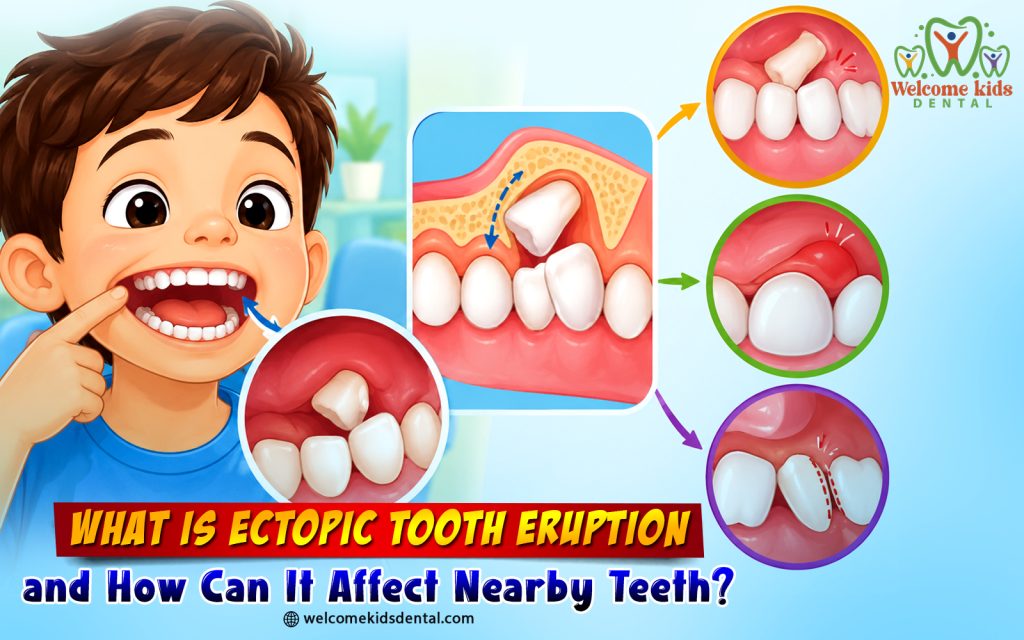
Children’s teeth do not always erupt in a perfectly predictable position. Sometimes, a permanent tooth begins coming into the mouth at an unusual angle or follows a path that is different from its normal eruption route. This is known as ectopic eruption. While it may not always cause immediate discomfort, an ectopically erupting tooth can affect nearby teeth, spacing, and the way a child’s bite develops.
Parents may notice a permanent tooth appearing behind, in front of, or at an unusual angle compared with the surrounding teeth. In other cases, there may be no obvious sign at home, and the issue is identified during a routine dental examination or X-ray.
Understanding ectopic eruption in children can help parents recognize changes in their child’s developing smile and know when professional evaluation may be appropriate. Early monitoring can be particularly helpful when a tooth appears to be taking an unusual path or when another tooth seems unable to erupt normally.
What Is Ectopic Eruption in Children?
Ectopic eruption occurs when a tooth develops or erupts along an abnormal path rather than following its expected route into the dental arch. The tooth itself may be healthy, but its position or direction of eruption can interfere with neighboring teeth.
This can happen with both baby and permanent teeth, although ectopic eruption is more commonly discussed when permanent teeth are developing.
A tooth may appear:
- Behind another tooth
- In front of another tooth
- At an unusual angle
- Outside the normal dental arch
- Crowded against a neighboring tooth
- Partially erupted while another tooth remains blocked
- In a position that makes the teeth appear uneven
The upper first permanent molars are among the teeth that can develop an ectopic eruption pattern. However, other teeth can also erupt abnormally depending on the child’s dental development.
Ectopic eruption does not automatically mean that a child will need extensive orthodontic treatment. Some mild cases may correct themselves as the child grows and the teeth continue developing. Other cases require closer monitoring or treatment to prevent damage to neighboring teeth.
The important question is not simply whether a tooth looks slightly out of position. A pediatric dentist needs to determine why the tooth is taking an unusual path and whether that path could interfere with normal dental development.
What Causes Ectopic Eruption in Kids?
There is not always one clear cause of ectopic eruption. Several factors can influence the position and direction in which a developing tooth erupts.
Limited Space in the Dental Arch
A developing tooth needs sufficient room to move into its expected position. When there is not enough space, the tooth may follow a different path. Crowding can occur because the teeth are relatively large compared with the available space, the dental arch is narrow, or several teeth are competing for limited room.
Abnormal Tooth Position
The developing tooth may naturally be positioned differently within the jaw. If its starting position or angle is unusual, its eruption path may also be affected.
This does not necessarily mean that anything is wrong with the child’s overall dental development. However, the tooth may need to be monitored to determine whether it eventually moves into a more appropriate position.
Retained Baby Teeth
A baby tooth that remains in place longer than expected can sometimes interfere with the eruption of the permanent tooth underneath it. If the permanent tooth cannot follow its normal path, it may begin moving around the retained baby tooth or emerge in an unusual location.
Early Loss of Baby Teeth
Losing a baby tooth too early can also change the amount of space available for the permanent tooth. Nearby teeth may shift into the space, leaving less room for the developing permanent tooth.
This is one reason parents should discuss premature tooth loss with a pediatric dentist rather than assuming that the permanent tooth will simply grow in normally.
Crowding or Narrow Dental Arches
Children with significant crowding may have less room for permanent teeth to erupt. When several developing teeth compete for space, one or more may take an abnormal path.
This is particularly important during the mixed-dentition stage, when children have a combination of baby and permanent teeth.
Extra or Missing Teeth
An extra tooth can physically block a permanent tooth from erupting normally. Similarly, the absence of a permanent tooth can alter the expected pattern of eruption and spacing. Dental X-rays can sometimes identify these issues before they become obvious in the mouth.
Growth and Development
A child’s jaws and facial structures continue changing throughout childhood. Differences in jaw growth, tooth size, and dental arch development can influence how permanent teeth move into position.
For this reason, dentists often look at the overall pattern of development rather than examining one tooth in isolation.
What Signs of Ectopic Eruption Should Parents Notice?
Ectopic eruption is not always easy for parents to identify. A tooth may appear only slightly different from the surrounding teeth, or the problem may be visible only on an X-ray.
However, there are several changes parents can watch for as their child’s permanent teeth come in.
A permanent tooth appears behind or in front of another tooth:
One of the more noticeable signs is a permanent tooth emerging in an unusual position instead of directly replacing a baby tooth.
A tooth appears to be coming in at an angle:
A tooth that is noticeably tilted, rotated, or directed toward another tooth may warrant evaluation.
A baby tooth remains while a permanent tooth starts appearing elsewhere:
Parents may notice a permanent tooth emerging behind or beside a baby tooth that has not fallen out yet.
One permanent tooth does not appear when expected:
A delay does not always mean ectopic eruption, but a missing tooth can sometimes be blocked or following an abnormal path.
Crowding suddenly becomes more noticeable:
As permanent teeth erupt, parents may notice that a tooth appears squeezed between neighboring teeth or that the dental arch has become more crowded.
A child has an uneven-looking developing smile:
Changes in tooth position can sometimes make one side of the smile look different from the other.
Parents should remember that children’s teeth naturally look uneven during certain stages of development. A slightly unusual-looking tooth does not automatically indicate ectopic eruption. The concern is greater when a tooth appears unable to follow its normal eruption path or when its position affects neighboring teeth.
How Is Ectopic Eruption Diagnosed and Treated?
A pediatric dentist usually begins with a clinical examination. The dentist looks at the child’s teeth, dental arch, bite, spacing, and overall eruption pattern. The child’s age and stage of dental development are also important. A tooth that appears unusual in a younger child may not be concerning if it is still within a normal developmental range.
When the position of a developing tooth cannot be fully evaluated by looking inside the mouth, dental X-rays may be recommended. Imaging can help the dentist determine:
- Where the developing tooth is located
- The direction in which it is moving
- Whether another tooth is blocking its path
- Whether a baby tooth is being retained
- Whether there is enough space for the tooth
- Whether an extra or missing tooth may be affecting eruption
- Whether neighboring teeth could be affected
Treatment depends on the individual situation.
Monitoring
If the tooth has a reasonable chance of correcting its position naturally and there is no evidence of damage to neighboring teeth, the dentist may recommend monitoring. Regular examinations allow the dental team to track whether the tooth is moving in the expected direction.
Managing a Retained Baby Tooth
If a baby tooth is preventing a permanent tooth from erupting normally, the dentist may determine whether removing the baby tooth is appropriate. This decision depends on the child’s age, the position of the permanent tooth, and the overall eruption pattern.
Creating or Preserving Space
If insufficient space is contributing to the problem, treatment may focus on maintaining or creating room for the permanent tooth. The approach depends on the child’s stage of dental development and the location of the affected tooth.
Orthodontic Treatment
Some children may eventually need orthodontic treatment to guide an ectopically positioned tooth into a healthier position. Orthodontic treatment is not automatically required for every case. The goal is to determine whether intervention would improve the child’s dental development, bite, or long-term tooth position.
The treatment plan should therefore be based on the cause and severity of the eruption problem rather than simply how the tooth looks.
How Can Welcome Kids Dental Help Monitor Ectopic Eruption?
At Welcome Kids Dental, monitoring how a child’s teeth develop is an important part of identifying potential dental and orthodontic concerns early.
During routine visits, the dental team can evaluate the position of developing teeth, the available space in the dental arch, the child’s bite, and changes that occur as baby teeth are replaced by permanent teeth.
Parents can bring up concerns if they notice that a permanent tooth is:
- Coming in behind another tooth
- Appearing at an unusual angle
- Not erupting when expected
- Crowded against another tooth
- Developing differently from the teeth on the opposite side
The dentist can then determine whether the change appears to be part of normal development or whether closer observation is appropriate.
Regular preventive visits also provide opportunities to identify other factors that may influence tooth eruption, including retained baby teeth, crowding, spacing concerns, and changes in the developing bite.
For families looking for Pediatric preventive dentistry, routine dental visits can provide more than cavity checks. Monitoring tooth development allows dental concerns to be identified while a child is still growing and before a developing problem becomes more complicated.
Parents may also receive guidance about brushing, flossing, and maintaining healthy teeth while permanent teeth are coming in. Keeping newly erupted teeth clean is particularly important because these teeth still need time to mature and are vulnerable to decay.
When Should Parents Have an Ectopically Erupting Tooth Checked?
Parents do not need to panic whenever a child’s tooth looks slightly unusual. Children’s teeth can appear uneven during normal eruption, and many temporary changes resolve as other teeth come in.
However, it is a good idea to schedule an evaluation if:
- A permanent tooth is erupting significantly behind or in front of the expected position.
- A baby tooth remains while the permanent tooth appears elsewhere.
- A permanent tooth has not erupted while neighboring teeth have already come in.
- A tooth appears to be pressing against another tooth.
- Crowding is becoming more noticeable.
- Your child experiences pain, swelling, or persistent discomfort around an erupting tooth.
- A dentist has previously mentioned an unusual eruption pattern.
- You are concerned about changes in your child’s developing bite.
Early evaluation does not necessarily mean treatment. In many cases, the most appropriate step is simply to monitor the tooth over time.
The purpose of an examination is to understand what is happening beneath the surface and determine whether the tooth is likely to correct its position naturally or whether intervention may be helpful.
Conclusion
Ectopic eruption in kids occurs when a tooth follows an unusual path as it develops and erupts into the mouth. Parents may notice a permanent tooth appearing behind or in front of another tooth, erupting at an angle, remaining partially blocked, or failing to appear when expected. Although some cases can correct naturally, an ectopically erupting tooth can sometimes interfere with neighboring teeth, available space, and the developing bite. That is why monitoring the eruption of permanent teeth is an important part of children’s dental care.
If you notice an unusual eruption pattern, a retained baby tooth, increasing crowding, or a permanent tooth that does not seem to be coming in normally, discuss it with your child’s dentist. At Welcome Kids Dental, regular examinations can help track dental development and identify concerns that may benefit from early attention. Understanding how your child’s teeth are developing can help you recognize changes early and support a healthy, functional smile as permanent teeth come in.